
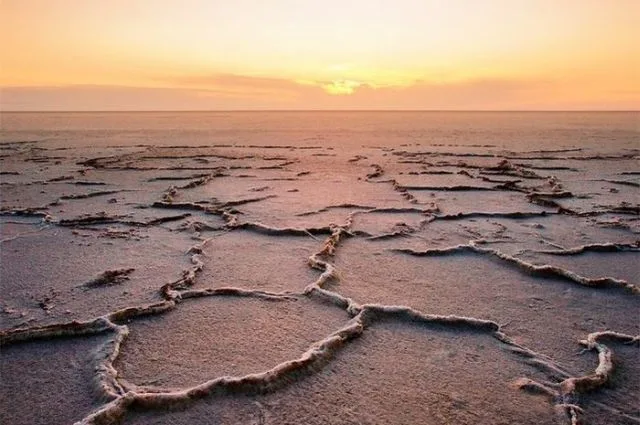
The crisis
Once the world's fourth-largest lake — about 68,000 km² and roughly 1,100 km³ of water around 1960 — the Aral Sea lost well over 90% of its surface after Soviet-era irrigation diverted the Amu Darya and Syr Darya. What remains is no longer one sea: since Kazakhstan completed the Kokaral Dam in 2005, the North (Small) Aral has partially recovered in area, volume, and fisheries, while the South (Large) Aral — especially its eastern basin, dry by 2014 — has largely become the Aralkum Desert, leaving a shrinking western remnant.
The ecosystem of the Aral Sea and the river deltas feeding into it has been nearly destroyed, not least because of the much higher salinity. The land around the Aral Sea is also heavily polluted, and the people living in the area are suffering from a lack of fresh water, as well as from a number of other health problems.
The receding sea has left huge plains covered with salt and toxic chemicals, which are picked up and carried away by the wind as toxic dust and spread to the surrounding area. Salt and chemical dust from the exposed seabed still harm health, crops, and livelihoods across Karakalpakstan and neighboring regions. The population around the Aral Sea now shows high rates of certain forms of cancer and lung diseases, as well as other diseases. Children and mothers live with unsafe water, toxic dust, respiratory illness, and other maternal and child health harms tied to the dried seabed. Crops in the region are also destroyed by salt being deposited onto the land.
Aral Sea Foundation helps children and mothers in communities hit by the Aral Sea crisis — clean water, maternal and child health support, and green belts against toxic dust.